

How to Lower Your CT Electric Bill This Summer
When the New England winter finally breaks and gives way to coastal Connecticut’s beautiful summer days, residents across Norwalk, Stamford, and Fairfield County flock outside to enjoy the Long Island Sound. However, as July and August roll in, a less welcome seasonal reality hits our mailboxes: soaring utility statements. Between rising regional energy rates and the relentless humidity pushing our cooling systems to their limits, finding sustainable, practical strategies on how to lower electric bill payments becomes a top priority for local homeowners.
For modern Connecticut families, managing this expense isn’t just a matter of financial health; it is increasingly about minimizing our environmental footprint. Every kilowatt-hour saved reduces the burden on our regional power grid and decreases greenhouse gas emissions. At Climate Care in Norwalk, we believe that true indoor comfort exists at the intersection of financial savings and “Green” living. You do not have to sacrifice a cool, healthy home to achieve a sustainable lifestyle or a lower utility statement.
This comprehensive master guide breaks down the science and strategies behind seasonal energy conservation. From immediate, zero-cost behavioral shifts to high-impact technical optimizations for your heating, ventilation, and air conditioning (HVAC) systems, here is exactly how to protect your wallet and the planet this summer.
The Connecticut Energy Landscape: Why Summer Costs So Much
To implement an effective savings strategy, it helps to understand why utility costs in Connecticut are uniquely challenging. According to data from the U.S. Energy Information Administration (EIA), Connecticut consistently ranks among the highest states in the continental U.S. for residential electricity rates. Our regional grid, managed by ISO New England, relies on a complex mix of natural gas, nuclear power, and an evolving framework of renewable energy assets.
During the summer, electricity demand spikes dramatically due to air conditioning. This forces the grid operators to activate “peaker plants”—older, less efficient, and more expensive generation facilities—to prevent brownouts. The result is a surge in supply costs. When you combine high base rates with high seasonal consumption, bills can easily double or triple compared to spring averages.
Furthermore, coastal Connecticut deals with intense humidity. Your air conditioner has a dual job: it must lower the air temperature and pull moisture out of the air. Humid air holds heat much more effectively than dry air, meaning your system has to work twice as hard to achieve the same perceived level of comfort. Understanding this interaction gives us our first major clue on how to lower electric bill costs permanently: we must address both temperature and moisture control.
1. Technical HVAC Optimization: The Core of Summer Savings
Because cooling accounts for over 50% of an average home’s energy use during a Connecticut summer, your HVAC system is the single most important variable in your strategy. A neglected cooling unit acts like a siphon on your bank account.
The High Cost of Dirty Filters
The simplest, most impactful recurring task a homeowner can perform is checking and replacing the HVAC air filter. Over a month of heavy summer operation, a filter accumulates dust, pet dander, pollen, and airborne particles common to the Norwalk area. This buildup chokes the airflow into your system.
When airflow is restricted, the blower motor must work harder and run longer to circulate conditioned air through your home. This translates directly into elevated electricity consumption. According to the Department of Energy, replacing a dirty, clogged filter with a clean one can lower your air conditioner’s energy consumption by 5% to 15%. Make it a rule to inspect your filter every 30 days during peak cooling season.
Professional Maintenance: More Than a Tune-Up
Just like a high-performance vehicle, a central air conditioning system or air-source heat pump requires professional calibration to operate at peak efficiency. A comprehensive seasonal tune-up by a certified technician ensures that all components operate exactly as the manufacturer intended.
Green Living Insight: The Clean Coil Advantage Your outdoor condenser unit contains sensitive metallic coils responsible for dissipating the heat pulled from inside your house. When these coils are coated in dirt, lawn clippings, or pollen, they become insulated. Heat cannot escape efficiently, forcing the compressor to run hotter and pull significantly more electrical current. Professional chemical cleaning of these coils dramatically drops system power draw.
Whether you require proactive seasonal maintenance to protect your investment or emergency fixes visit at Climate Care, our technicians check refrigerant levels, inspect electrical connections, lubricate moving parts, and verify thermostat calibration. A system short on refrigerant by even a few ounces can drop in operational efficiency by up to 20%, costing you money every hour it runs without providing proper cooling.
2. Thermostat Mastery: Strategic Coding for Green Living
Many homeowners misunderstand how thermostats interact with their cooling hardware. A common myth is that setting your thermostat to an extremely low temperature (like 65°F) will cool the house down faster. In reality, air conditioners run at a fixed speed and capacity; setting it lower simply forces it to run for a longer, more expensive duration.
The 78-Degree Standard and the 8-Degree Rule
For the optimal balance of eco-friendly living and financial management, the U.S. Department of Energy recommends setting your thermostat to 78°F (26°C) when you are home and awake. While this might sound warm to some, reducing the delta—the difference between the outdoor temperature and your indoor setting—drastically slows the rate at which heat penetrates your home structure.
If 78°F feels uncomfortable initially, try lowering it incrementally by one degree each day to allow your body to acclimate. For every degree you raise your thermostat above 72°F, you can save roughly 3% to 5% on your cooling costs.
When you leave your house for work or day trips around Fairfield County, apply the 8-degree rule. Program your thermostat to go up to 85°F while you are away. Keeping the house closer to the outside temperature minimizes heat transfer into the building, meaning your system will require less total energy to cool things back down when you return than it would have consumed maintaining a cool 72°F all day long in an empty house.
Leveraging Smart and Programmable Thermostats
Manually adjusting your thermostat multiple times a day is tedious, and human error often leads to wasted power. Upgrading to a smart thermostat (such as a Nest or Ecobee) is one of the fastest ways to realize a return on your investment when figuring out how to lower electric bill metrics.
Smart thermostats learn your daily routines, automatically adjusting temperatures when you sleep or commute. Advanced models use geofencing technology, tracking your smartphone’s location to start cooling your Norwalk home the moment you leave your office, ensuring you never waste power cooling an empty space while guaranteeing a comfortable arrival.
3. The Green Physics of Airflow: Fans and Ventilation
Mechanical air conditioning shouldn’t do all the heavy lifting. By understanding basic fluid dynamics and using natural airflow, you can create a highly efficient microclimate inside your home.
The Counterclockwise Ceiling Fan Trick
Ceiling fans are incredibly efficient tools for sustainable comfort, but only if they are spinning in the correct direction. In the summer, verify that your ceiling fans are rotating counterclockwise at medium to high speed. This direction creates a direct downward breeze, producing a convective cooling effect on your skin.
Note: Ceiling fans cool people, not rooms. The wind-chill effect makes an individual feel up to four degrees cooler than the ambient air temperature, allowing you to set your thermostat higher without any loss in personal comfort. However, because fans do not actually lower the room’s air temperature, running a fan in an empty room is pure energy waste. Turn them off when you leave the space.
Strategic Nighttime Ventilation
While Connecticut summers are famously humid, there are clear desert-like stretches or crisp coastal evenings where nighttime temperatures drop below 70°F. When these conditions occur, turn off your air conditioner entirely and open your windows to take advantage of natural cross-ventilation.
To maximize this effect, place a box fan in a window on the leeward side of your home (blowing outward) and open a window on the windward side. This creates a vacuum effect, actively pulling cool evening air through your living spaces and flushing out the thermal mass accumulated in your drywall and furniture during the day. Close the windows early the next morning before the sun hits your walls to trap that cool air inside.
4. Advanced Home Thermodynamics: Windows, Insulation, and Air Leaks
Think of your home as a thermal envelope. No matter how efficient your HVAC unit is, if your home leaks conditioned air and absorbs external heat like a sponge, your utility costs will remain stubbornly high.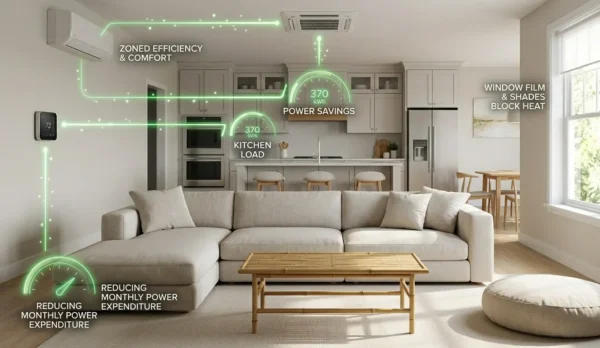
The Greenhouse Effect in Your Living Room
Solar radiation passing through clean window glass is a massive contributor to internal heat gain. Unprotected windows facing south and west can act like miniature space heaters, forcing your AC into an endless operational cycle.
The green solution is simple: deploy strategic window treatments. High-efficiency window shades, cellular blinds, or heavy drapes can reduce solar heat gain by up to 77% when closed during peak sunlight hours. For a permanent, hands-off solution, consider applying low-emissivity (Low-E) architectural window films. These micro-thin metallic coatings reject infrared heat waves while allowing visible light to pass through perfectly, keeping your rooms bright but thermally isolated.
Sealing Structural Air Leaks
Many Norwalk homes feature beautiful historic architecture, but older construction often comes with significant structural settling and subsequent air leaks. Cool air escapes through gaps around exterior doors, window sashes, plumbing penetrations, and electrical outlets, while hot, humid air rushes in to take its place. By addressing these structural gaps, you significantly protect your home’s insulation and airflow efficiency, easing the continuous load on your central cooling system.
Conduct a DIY thermal audit: on a hot day, run your hand along the trim of your windows and baseboards. If you feel cool air leaking out, seal those areas. Use high-grade exterior silicone caulk for permanent structural gaps, and install fresh V-strip or foam weatherstripping along moving door and window frames. This simple afternoon project reduces your home’s total air infiltration rate, easing the continuous load on your HVAC hardware.
Attic Insulation: Your Thermal Shield
During a clear July day, your roof absorbs intense solar radiation, heating your attic space up to 140°F or higher. If your attic floor is poorly insulated, this intense heat radiates downward through your ceiling right into your bedrooms.
Upgrading your attic insulation to modern building standards (typically an R-49 to R-60 value for Connecticut, which equals roughly 16 to 19 inches of blown-in cellulose or fiberglass) creates a robust barrier. This keeps attic heat out of your living zones, making it vastly simpler to maintain lower indoor temperatures while ensuring your cooling infrastructure runs significantly less often.
5. Everyday Household Habits for Low-Impact, Green Living
Sometimes, learning how to lower electric bill payouts comes down to modifying our daily operational habits. Small actions, multiplied over a 90-day summer cycle, result in noticeable cumulative financial and ecological benefits.
Managing Internal Heat Loads
Your family actively generates heat and humidity indoors through standard daily tasks. Major appliances like ovens, stoves, dishwashers, and clothes dryers dump substantial BTUs of heat directly into your conditioned space.
-
Outdoor Cooking: Embrace summer living by shifting your cooking outdoors to a grill. This keeps cooking heat out of your kitchen entirely.
-
Appliance Timing: Run your dishwasher and clothes dryer late at night or early in the morning when the ambient outdoor temperatures are cooler, minimizing the compounding thermal stress on your AC.
-
Ventilation Fans: Always run your bathroom exhaust fans during showers and kitchen hoods while boiling liquids. This captures moisture at the source and exhausts it outside before it can humidify your entire home layout. Managing internal humidity is a critical pillar of your overall home comfort, so be sure to explore specialized indoor air quality solutions to permanently capture moisture and air particles at the source.
The Shift to LED Lighting
If you are still utilizing older incandescent lightbulbs in your home, you are effectively running tiny heaters. Incandescent bulbs convert a shocking 90% of their consumed electrical energy into ambient heat, leaving only 10% for actual light production. Transitioning your fixtures to modern light-emitting diode (LED) alternatives instantly slashes your lighting power draw by up to 80% while keeping your indoor spaces noticeably cooler.
6. Strategic Upgrades: The Long-Term Clean Energy Vision
If your cooling infrastructure is more than 10 to 15 years old, routine maintenance can only achieve so much. True sustainable leadership and dramatic financial relief often require upgrading to modern, high-efficiency clean energy systems.
Deconstructing Efficiency Metrics: SEER2
When purchasing new cooling equipment, pay close attention to the Seasonal Energy Efficiency Ratio 2 (SEER2) rating. This metric measures the total cooling output of a system relative to its total electrical consumption over a typical regional cooling season. Older systems operating in Fairfield County may feature SEER ratings as low as 10 or 12. Modern high-efficiency systems reach SEER2 levels of 18 to 26+. Upgrading from an old SEER 10 system to a contemporary SEER2 system can slash your cooling power costs in half instantly, permanently changing your baseline energy consumption patterns.
The Rise of Variable-Speed Technology
Traditional air conditioners run on an “all-or-nothing” cycle. The system turns on at 100% capacity, runs loudly until the thermostat is satisfied, and then shuts down completely. This constant on-and-off cycling draws massive amounts of electrical current during startup and creates uncomfortable temperature swings.
Modern high-efficiency systems utilize variable-speed inverter compressors. These systems can modulate their output precisely, running continuously at lower capacities (as low as 25% or 30%) to match the actual heat load of your home. By operating at lower speeds for longer periods, they maintain perfectly steady temperatures, dehumidify your indoor air far more effectively, and draw a fraction of the electricity of a standard system.
Ductless Mini-Splits: Zoned Eco-Efficiency
For homes without existing ductwork, or spaces with chronic temperature imbalances, ductless mini-split systems offer an incredibly elegant green solution. These systems feature independent indoor air handlers connected to a single outdoor compressor unit. Climate Care installs high-efficiency air-source and ductless mini-split systems, perfect for homes of all sizes throughout Fairfield County looking to avoid leaky attic ducts.
Mini-splits allow for precise, localized zoning. If your family spends the evening in the living room, you can cool that zone perfectly while letting the empty bedrooms remain warmer. By eliminating the thermal losses associated with traditional leaky attic ductwork—which can lose up to 30% of conditioned air to unconditioned spaces—ductless systems deliver unmatched efficiency profiles.
Take Advantage of Connecticut Clean Energy Incentives
The state of Connecticut is deeply committed to reducing carbon emissions, meaning there are excellent financial assistance options available for local property owners looking to transition to green living solutions. Through the Energize Connecticut initiative, residents can access massive rebates, subsidized home energy audits, and low-interest financing options for energy efficiency improvements.
By scheduling a Home Energy Solutions (HES) assessment, certified technicians will evaluate your home’s insulation, perform blower-door air leakage tests, and even seal critical air leaks on the spot. Furthermore, federal incentives under the Inflation Reduction Act provide robust tax credits (up to $2,000 annually) for qualifying high-efficiency air-source heat pumps and central AC systems, making it more affordable than ever to invest in premium green HVAC technology.
Partner with Norwalk’s Trusted Green HVAC Experts
Ready to master your indoor comfort, lower your environmental impact, and take control of your utility costs this summer? The dedicated team at Climate Care is here to help. From precision engineering tune-ups to advanced variable-speed inverter and ductless system designs, we provide specialized, eco-friendly comfort solutions tailored to your unique Norwalk home.
Contact Climate Care today to schedule your comprehensive AC maintenance or high-efficiency system consultation. Let’s make this summer comfortable, sustainable, and affordable together!